Where to stay in Nice
Nice hands every car two free hours a day on the street and then bans parking beyond two hours fifteen. That one rule decides where a car sleeps and which quarter is worth booking.
Last checked
How the areas differ
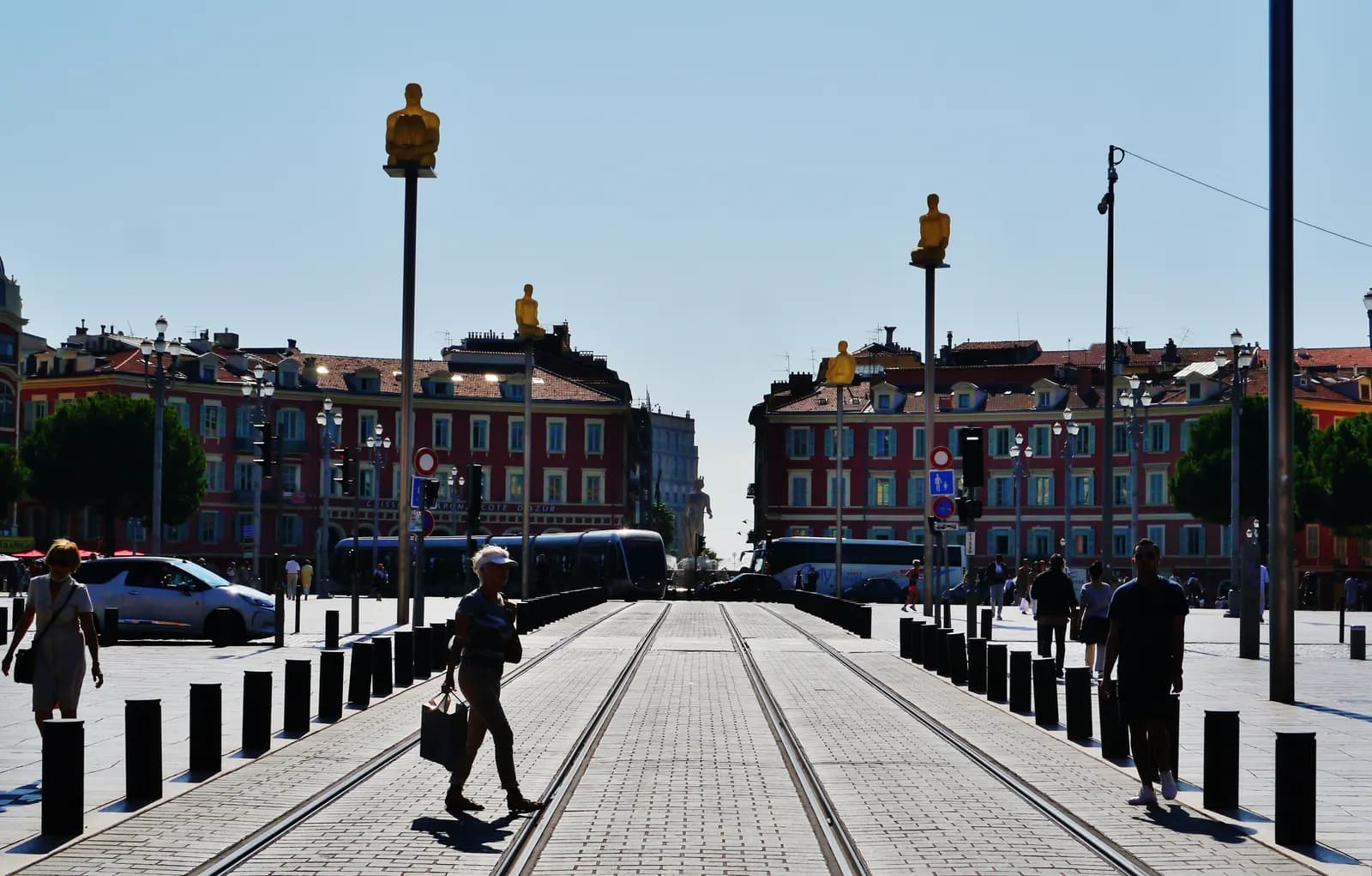
Vieux Nice is the old town behind the seafront, with the Cours Saleya market under its striped awnings, about 1 km from the Place Masséna. The centre and the Carré d'Or wrap around that square, where the tram crosses the paving between red arcaded buildings, and the two are a few minutes apart on foot.
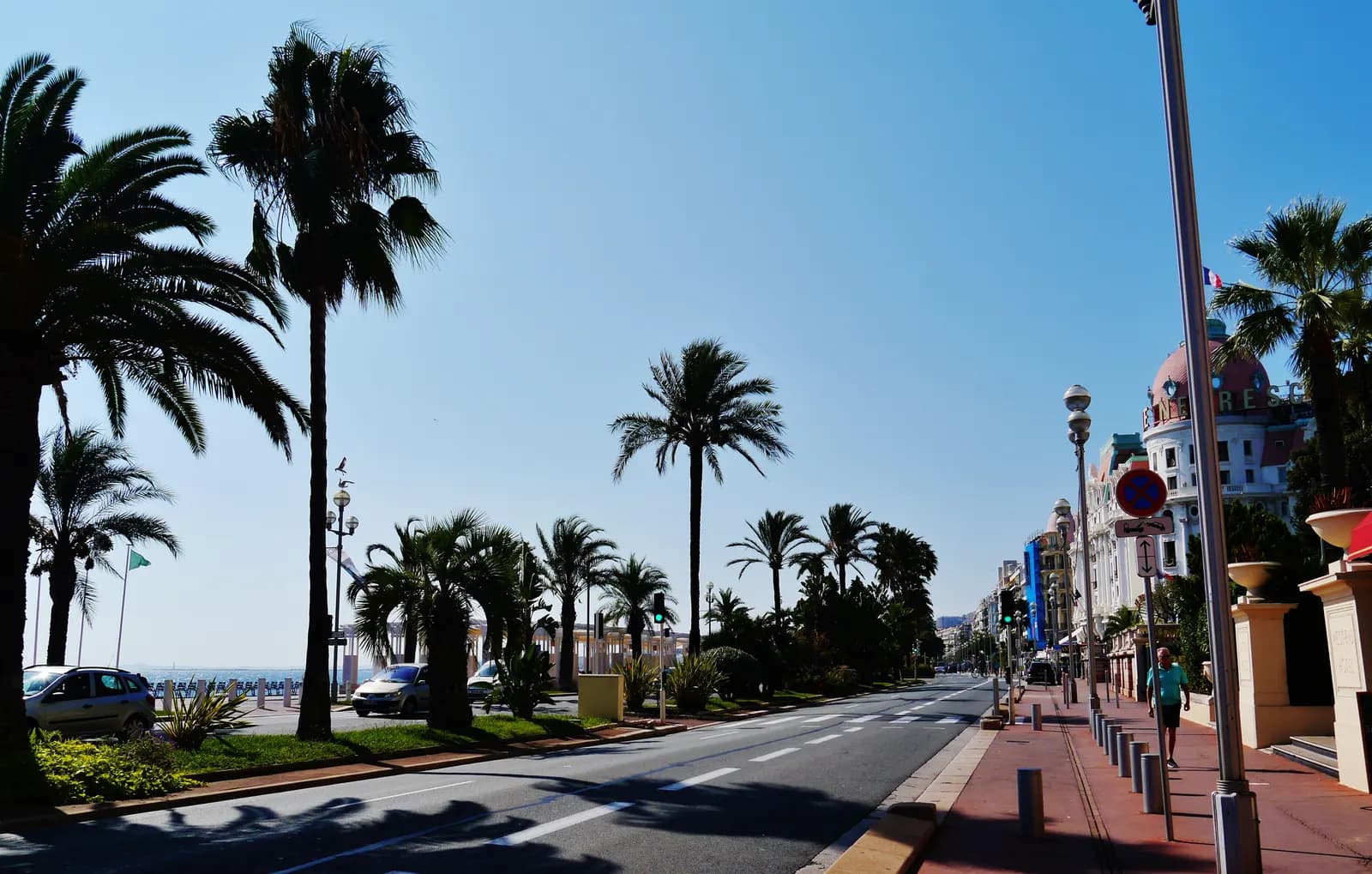
The Promenade des Anglais is the bay itself, palms and hotels facing the water, about 4 km from Masséna by road because the seafront is a one-way system. East of the old town, Port Lympia lies under the wooded hill of Mont Boron, about 3 km out, and tram line 2 ends there.
Nice Ouest and the Arénas sit beside the airport, about 3 km from the terminals and about 6 km from the centre, around the Grand Arénas interchange where tram lines 2, 3 and B meet.
Parking, and why it is the deciding factor
Street parking inside the marked perimeter is charged from Monday to Saturday, 9am to 7pm, and is free on Sundays and public holidays. Every vehicle gets two consecutive hours free each day, but only on condition of taking a free ticket at a meter or in the app under code 861; a car registered as emitting no CO2 gets two hours fifteen. After the free period the scale is short and cheap: EUR 0.50 for 35 minutes, EUR 1.20 for an hour, EUR 2.40 for two.
The ceiling counts for more than the price. The city is explicit that parking for more than two hours fifteen is forbidden, and that going over it costs a forfait post-stationnement of EUR 25. A car cannot sit outside the flat for an afternoon, let alone a night.
The answer is a car park. The Régie Parcs d'Azur, a public undertaking of the métropole, runs them under the name Nice Azur Parking, and the City gives a free first hour at ten of them, including Saleya in the old town, Palais Masséna and Promenade des Arts in the centre and Saint Roch towards the port, with 30 free minutes at Mozart and Acropolis. Parcazur park and ride sites sit beside the tram for anyone willing to leave the car at the edge. Rental cars for the trip are on GetCar's car rental page for Nice.
The national list restricts only heavy goods vehicles in Nice, at Crit'Air 3, and says nothing about cars or light vans. Parliament voted to repeal the articles that created the low-emission zones in the law of 26 May 2026; how that applies in Nice was unverified as of September 2026.
The tourist tax and the letting rules
The Métropole Nice Côte d'Azur charges the tax, on rates in force since 1 January 2025. Per person per night, with the 34 per cent regional addition for the Ligne Nouvelle Provence Côte d'Azur already included, that is EUR 6.43 in a palace, EUR 4.69 at five stars, EUR 3.48 at four, EUR 2.28 at three, EUR 1.34 at two and EUR 1.07 at one star or in a chambre d'hôtes. There is no departmental addition in the Alpes-Maritimes.
An unclassified flat pays 6.70 per cent of the cost of the night per person before tax, which is the métropole's 5 per cent plus the 1.70 per cent addition, capped at EUR 6.43 per person per night. The host collects it, or the platform does when it takes the payment.
Nice regulates its tourist flats harder than most French cities. A second home needs a change-of-use authorisation from the city's housing protection unit before it can be registered at all, and only then does the métropole portal issue the registration number the platforms ask for. On 19 June 2026 the city council recorded that four sectors, Vieux-Nice, the centre, Riquier with the port and Mont Boron, and the west, hold about 70 per cent of the listings, and that those sectors are capped at 691 temporary authorisations for 2026, about 0.9 per cent of their housing stock, with filing reopened on 1 September 2026 and new authorisations running five years without renewal.
The same session approved raising the ceiling on letting a main residence as a tourist flat to 120 days a year, up from 90. Guests who are not French nationals fill in a fiche de police at check-in, which the host keeps for six months.
When to book what
If the car is only for day trips along the coast, book in the centre or the old town and plan on a car park from the first night. If the car is the point of the trip, the west by the Arénas keeps it out of the dense streets and close to the motorway.
For arrivals without a car, tram line 2 reaches Jean Médecin in under 30 minutes from either terminal and runs every 7 to 8 minutes on weekdays. Compare and book on this page.
Which area for which trip
A first visit on foot and a market every morning: Vieux Nice.
Shops, the tram and the squares: the centre and the Carré d'Or.
The sea from the window: the Promenade des Anglais.
Boats, a quieter quay and the end of the tram: Le Port, Riquier and Mont Boron.
An early flight or a car-led trip: Nice Ouest and the Arénas.
Questions
How do the two free parking hours in Nice work?
Take a free ticket at a meter or in the app with code 861. Every vehicle gets two consecutive hours a day, Monday to Saturday, and a zero-CO2 car gets two hours fifteen.
What happens after two hours fifteen?
Parking is forbidden beyond that on a street space, and the charge is a forfait post-stationnement of EUR 25. A longer stop belongs in a Parcs d'Azur car park.
Is parking free at the weekend in Nice?
On Sundays and public holidays, yes. Saturdays are charged like weekdays, from 9am to 7pm.
Which car parks give a free hour?
Saleya, Palais Masséna, Promenade des Arts, Corvésy, Palmeira, Les Bosquets, Marshall, Palais de Justice, Saint Roch and Sulzer. Mozart and Acropolis give 30 minutes.
Is there a low-emission zone that stops a hire car in Nice?
No. The national list restricts only heavy goods vehicles in Nice, at Crit'Air 3, and cars and light vans are not covered.